

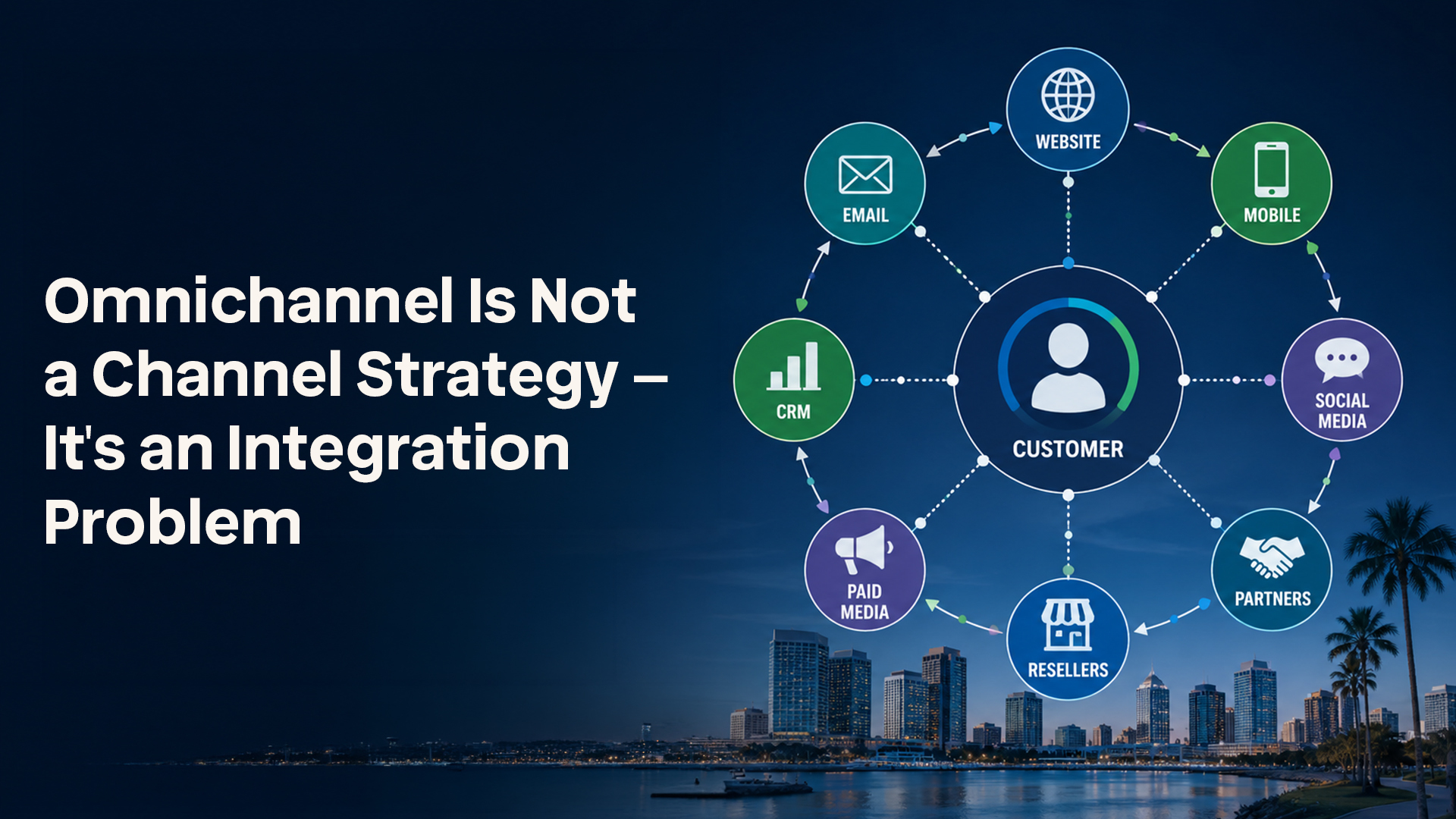
Here is a conversation that happens in marketing meetings constantly: someone says “we need an omnichannel strategy,” and what gets built is a plan to show up on more platforms. More social accounts. More ad channels. A podcast, maybe. A newsletter that goes out when someone remembers to write one. The channels multiply. The results don’t.
That gap between intent and outcome isn’t a channel problem. It’s an integration problem. And until that distinction lands clearly, adding new channels doesn’t improve the strategy — it makes it harder to manage, harder to measure, and harder to fix when something isn’t working.
This matters especially for businesses running partner programs, reseller networks, or any kind of distributed marketing effort, because those layers compound the integration challenge significantly, and they’re usually the last place anyone looks when a multichannel marketing strategy starts underperforming.
Multichannel vs Omnichannel – Not Just Semantics
The terms get used as synonyms constantly, but they describe different things. Multichannel means being present on more than one channel. A business with a website, a Facebook page, and a monthly email list is multichannel. So is a company running Google Ads and attending trade shows. Each channel exists and functions, but it functions independently, with its own team, its own content calendar, and its own logic.
Omnichannel means those channels are connected. Not just visually consistent (same logo, same colors), but operationally integrated: the customer’s behavior on one channel informs what they see on another; the data flows between platforms rather than sitting in separate dashboards; and the experience holds together whether someone first found you through a reseller, a paid search ad, or a referral from a partner.
The gap between the two is not cosmetic. Companies with strong omnichannel engagement strategies retain an average of 89% of their customers, while those with weaker strategies retain around a third. That gap in retention rate is not explained by how many channels a brand is present on — it’s explained by whether those channels are actually working together.
Why Most “Omnichannel” Strategies Are Just Multichannel with Better Branding?
The confusion is understandable. Building and managing individual channels is concrete — you can assign it to someone, set a budget, and measure it in isolation. Integration is harder to scope, harder to assign, and harder to explain to a CFO. So most organizations default to the thing they can execute immediately: adding channels.
Roughly 55% of marketers report difficulty integrating data across channels effectively, and 70% of consumers expect consistent experiences across all touchpoints, yet only 44% say brands actually deliver that consistency. That gap isn’t random. It’s the structural result of building channel-by-channel without solving the integration layer first.
The symptoms are recognizable. The email team doesn’t know what the paid media team is running. A customer who just converted through a reseller gets retargeted with acquisition ads for the product they just bought. A partner sends a campaign to the same list the brand emailed last week, with a different offer, at a slightly lower price. The website analytics and the CRM don’t agree on what a conversion is. None of these are channel problems. Every one of them is an integration failure.
The second biggest challenge B2C marketers report in driving customer engagement isn’t budget or creative; it’s executing omnichannel communication seamlessly, cited by more than half of marketers. That number reflects how common this failure pattern is and how consistently it gets misdiagnosed as a channel gap when it’s actually an operational and data architecture issue.
The Four Integration Layers That Define a Real Omnichannel Strategy?
When Centaur Strategies works with clients on channel management and multichannel marketing strategy, the conversation almost always reveals the same four layers and the same pattern of which ones have been built and which ones have been skipped.
Data integration is the foundation. Every channel your business uses generates data: website behavior, email engagement, ad performance, CRM records, partner pipeline updates, and reseller sales figures. In a multichannel operation, that data lives separately. In an omnichannel strategy, it’s unified into a customer profile that each channel can read and contribute to. Without data integration, personalization is guesswork, and attribution is a fiction.
Message integration is where most businesses feel like they’ve solved the problem because they have brand guidelines. Brand guidelines tell the design team how to use the logo. They don’t tell the channel partner what offer to lead with, how to handle a prospect already in the brand’s direct pipeline, or what to say differently on LinkedIn versus an email nurture sequence. Consistent visual identity and consistent messaging strategy are not the same thing.
Operational integration is the layer that determines whether data and message alignment actually hold under real conditions. Who decides when a partner campaign runs alongside a direct campaign? How does the reseller program flag a conflict? Who owns the customer experience when a channel partner hands a lead to the brand’s sales team? These aren’t channel problems. They are process and governance problems, and they sit squarely in the intersection of management consulting and channel marketing, exactly the combination that most marketing agencies aren’t built to handle together.
Experience integration is the outcome of getting the first three right. It’s what the customer actually encounters: a journey that feels deliberate rather than accidental, where switching from a social ad to a landing page to a follow-up email doesn’t feel like switching companies. 73% of retail shoppers interact across multiple channels before making a purchase decision, which means the experience between channels is not a secondary concern; it is the primary thing being evaluated before the sale happens.
Where Channel Partner and Reseller Programs Break the integration
Channel partner marketing and reseller marketing services introduce a specific and underappreciated integration challenge: you are now coordinating the customer experience across organizations that are not inside your own.
A reseller running their own paid campaigns for your product is operating on their own schedule, targeting their own interpretation of your audience, and making messaging decisions without necessarily knowing what your brand’s direct channels are doing that week. A channel partner sending a promotional email to a shared contact list may not know and has no built-in way to know that the customer they just emailed had a support ticket open since Tuesday.
This is where the “integration problem” framing becomes most useful. The answer is not to control everything the partner does. The answer is to design the integration layer so that information flows appropriately, conflicts are surfaced before they reach the customer, and the partner’s activity strengthens rather than contradicts the brand’s direct effort.
As a channel partner marketing agency, Centaur Strategies approaches this from both ends: the channel strategy that defines how partners fit into the brand’s overall go-to-market architecture and the execution infrastructure that makes coordination operationally real, not just a paragraph in the partner agreement. The biggest barrier to executing personalized omnichannel campaigns is slow execution caused by manual processes or rigid technology, and that barrier is significantly higher when the manual processes span multiple organizations that each have their own systems, timelines, and priorities.
How to Diagnose Your Integration Problem Before Adding Channels
Before a business invests in a new channel — a new social platform, a new partner tier, a new retargeting program — a basic integration audit is worth completing on what already exists. The questions that matter:
Do your analytics platforms agree on what constitutes a conversion, and can you trace the same customer across more than one touchpoint? If the answer is no, adding channels creates more discrepancy, not more clarity.
Does your CRM know which customers came through partner or reseller activity, and does that distinction affect how they’re subsequently marketed to? If the answer is no, partner-sourced customers are getting the same nurture sequences as cold leads, which means the partner relationship isn’t being leveraged even when it closed the deal.
Can your team see what partners are saying to your shared audience, and in what timeframe? If the answer is no, message conflicts are inevitable, and they’re invisible until a customer points them out.
Does your team have clarity on which channels are actually moving revenue, or are attribution discussions still unresolved? Nearly half of B2C marketers say their biggest challenge is not having clarity around channel effectiveness. You cannot optimize what you cannot measure, and you cannot measure it if the data isn’t integrated.
What Integrated Channel Management Looks Like in Practice
The practical difference between a multichannel marketing strategy and an integrated omnichannel approach shows up in how decisions get made. In a multichannel model, each channel team optimizes for its own metrics. In an integrated model, the channels are optimized relative to each other, email performance is read in the context of what paid media is doing, reseller activity is visible in the same reporting view as direct sales, and a channel that isn’t contributing to the overall system gets adjusted or deprioritized.
This requires infrastructure, the right platforms, the right integrations, and the right reporting framework. It also requires governance: clear ownership of the integration layer, agreed definitions across teams and partners, and a process for making decisions when channels conflict rather than letting conflicts persist.
At Centaur Strategies, digital marketing and Channel Management is a single service, not two services sold separately, because the separation is where most strategies break. Building campaigns without managing the channel architecture that delivers them is multichannel execution. Connecting those campaigns to a shared data layer, a coherent partner framework, and a measurement system that reflects the whole picture is what omnichannel actually means.
The same applies to analytics and reporting. Knowing that your LinkedIn campaign is performing well is useful. Knowing how it interacts with your reseller funnel, your email nurture, and your direct close rate is the intelligence that drives allocation decisions.
Ready to Diagnose Your Integration Gap?
Centaur Strategies offers a free consultation for businesses in San Diego and nationwide that want to understand where their channel strategy is functioning as a collection of independent efforts rather than an integrated system. Whether your challenge is data silos, channel partner alignment, reseller marketing coordination, or simply figuring out which channels are actually driving growth, that’s exactly the kind of problem this team is built to untangle.
Frequently Asked Questions
Q. What is the difference between multichannel and omnichannel marketing?
A. Multichannel marketing means being present on more than one channel — social, email, paid search, partner programs, and so on — with each channel managed relatively independently. Omnichannel marketing means those channels share data, consistent messaging, and operational coordination so the customer’s experience is seamless across all of them. The distinction matters because multichannel presence is a starting point, not an outcome. Most businesses that describe themselves as omnichannel are operating a multichannel strategy with consistent branding, which is not the same thing.
Q. Why do most omnichannel strategies fail?
A. The most common failure pattern is building channel-by-channel without first solving the integration layer. Data stays siloed across platforms, messaging decisions are made independently by separate teams or channel partners, and attribution becomes unresolvable. The result is that adding more channels makes the problem worse rather than better — more complexity, more discrepancy, and no clearer picture of what’s actually driving revenue. The fix is almost never a new channel. It’s an audit of the data, messaging, and operational infrastructure connecting the channels that already exist.
Q. What does a channel partner marketing agency actually do?
A. A channel partner marketing agency helps businesses design and manage the marketing relationship between a brand and its resellers, distributors, or partners. This includes defining how partners fit into the brand’s go-to-market strategy, what marketing support and materials they receive, how partner activity is tracked and attributed, and how conflicts between partner campaigns and direct campaigns are prevented or resolved. Done well, it extends the brand’s reach through partners without creating a fragmented customer experience. Done poorly, it creates messaging conflicts and attribution problems that are hard to untangle.
Q. What is reseller marketing, and when does a business need a dedicated reseller marketing strategy?
A. Reseller marketing covers the programs, content, incentives, and coordination that support third-party sellers who market and sell your product or service on your behalf. A dedicated reseller marketing strategy becomes important when the reseller channel is a meaningful portion of revenue, when multiple resellers serve overlapping markets or audiences, or when reseller messaging has started to diverge from the brand’s direct messaging. Without a structured approach, reseller programs tend to develop independently and inconsistently, which weakens the brand experience and makes it harder to grow the channel strategically.
Q. How do I know if my business has an integration problem rather than a channel problem?
A. A few reliable signals: your analytics platforms disagree on what’s converting and where; customers who came through a partner or reseller receive the same generic follow-up as cold leads; your paid media and email teams are unaware of each other’s current campaigns; your channel partners are running promotions on timelines and at price points that surprise your direct sales team. Any one of these is an integration issue. All of them together indicate that the integration layer was never built and that adding channels will increase the noise without improving the signal.
Q. Does Centaur Strategies work with businesses outside San Diego?
A. Yes. Centaur Strategies is headquartered in San Diego and serves clients across San Diego County — including La Jolla, Encinitas, Carlsbad, Del Mar, and Oceanside — as well as nationally and globally through remote delivery. The channel management, reseller marketing, and omnichannel strategy work the team does is industry- and geography-agnostic; what matters is the business model and the current state of the channel infrastructure.

