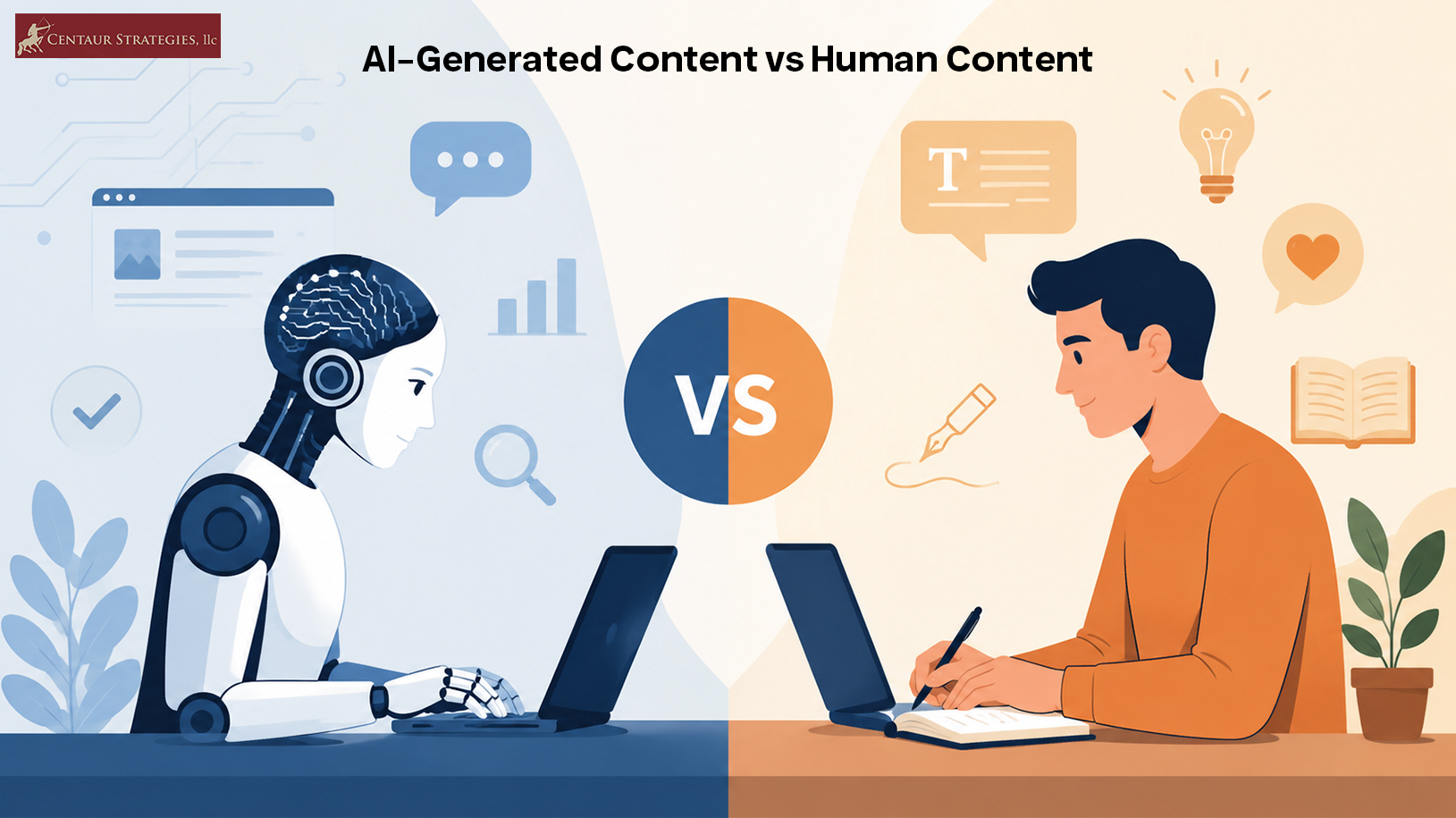
As generative AI becomes more capable, content teams must answer a central question: do audiences prefer AI-generated content or human-created content? The AI-generated content vs. human content debate isn’t about choosing one over the other by default — it’s about recognizing the strengths and limitations of both and aligning your content strategy with audience expectations and business goals. As a full-service digital marketing agency in San Diego, Centaur Strategies helps brands strike that balance, pairing AI efficiency with authentic, human storytelling that drives real results.
At its core, this comparison touches on quality, authenticity, emotional resonance, expertise, and trust, all essential for effective content that performs.
What Is AI-Generated Content?
AI-generated content refers to writing produced primarily by artificial intelligence systems based on training data and input prompts. It efficiently creates drafts of articles, summaries, and briefs; product descriptions at scale; SEO-optimized text; and consistent patterns for repetitive formats.
AI excels at speed and consistency, but its outputs derive from patterns and existing data rather than lived experience or intuition.
What Is Human Content?
Human content is created by people, writers, subject matter experts, strategists, and storytellers, and reflects personal insight and lived expertise, nuance and contextual understanding, tone, voice, and emotional intelligence, along with narrative craftsmanship and creative judgment.
Humans bring empathy, conceptual coherence, and strategic intent that AI alone cannot intrinsically generate. This is exactly why human oversight remains central to how Centaur Strategies, a full-service digital marketing agency in San Diego, approaches digital marketing for its clients.
What Audiences Actually Prefer: Key Dimensions
Audience preference isn’t binary. It depends on the context, content type, and intent. Below are the key dimensions that influence preference.
Relevance and Accuracy
AI can deliver high volumes of relevant content based on training data and keywords, making it especially useful for data-heavy or informational pieces. Humans, however, contextualize accuracy within real-world nuance, particularly important for evolving topics where expertise matters.
Audience Preference: When the topic is complex or sensitive, human content edges ahead because it reflects deeper understanding and real-world insight.
Engagement and Emotional Connection
AI can mimic tone and structure, but it lacks genuine emotional intuition. Human writers craft narratives that resonate, inspire, empathize, and connect. This distinction matters enormously in brand storytelling, where emotional engagement drives loyalty and action.
Audience Preference: Most audiences prefer human-crafted content when storytelling, brand voice, or emotional engagement are central to the experience.
Creativity and Original Thought
AI repurposes patterns and phrases from its training data but doesn’t originate novel concepts or insights. True originality, new metaphors, conceptual leaps, personal perspective, stems from human cognition. This is particularly relevant for thought leadership content and strategic positioning.
Audience Preference: Audiences seeking fresh ideas, perspective pieces, or visionary content prefer human creativity.
Consistency and Scalability
AI is unmatched for scale and speed, consistently replicating formats for product descriptions, local SEO pages, or structured documentation. Humans work best when quality matters more than volume, though high-volume output may strain timelines or budgets.
Audience Preference: For bulk or repetitive content, AI is acceptable, even preferred as long as quality controls are in place.
Trust and Authority
AI cannot inherently cite new research, verify facts beyond its training cutoff, or claim lived experience. Human experts cite sources, validate information, and build credibility over time. For analytics-driven content and reporting, audiences expect a level of authority that only human expertise can deliver.
Audience Preference: For authority content, research reports, professional advice, expert commentary, audiences trust human-generated content more.
When AI and Human Content Work Best Together
The most effective content strategies don’t treat AI and humans as competitors, they treat them as collaborators. As explored in our recent post on Digital Marketing Trends for 2026, AI is rapidly shifting from a novelty to a necessity, and businesses working with a digital transformation service in San Diego are learning to harness it without losing the human voice that drives real connection.
AI Strengths: Draft generation, SEO optimization, repetitive structured tasks, scalability and versioning.
Human Strengths: Depth and insight, contextual reasoning, narrative voice and brand nuance, ethical judgment and trustworthiness.
Best-in-class teams use AI to amplify human creativity, not replace it.
A Practical Comparison: AI vs. Human Content
Dimension | AI Content | Human Content | Audience Preference |
Speed | Very high | Moderate | Depends on urgency |
Accuracy | High (data-based) | High (expert-verified) | Human for depth |
Creativity | Pattern-based | Original insight | Human preferred |
Emotional Impact | Limited | Strong | Human preferred |
Scalability | Excellent | Limited | AI for volume |
Trust / Authority | Context-dependent | High | Human preferred |
This table reflects general tendencies, not absolutes. Audience preference shifts based on context, which is why a tailored content and digital marketing strategy will always outperform a one-size-fits-all approach.
Common Misunderstandings About AI Content
Myth 1: AI always reduces quality. Fact: When guided and refined by human editors, AI can produce high-quality outputs efficiently.
Myth 2: Human content is always better. Fact: For high-volume, structured tasks, AI may outperform human speed without compromising baseline quality.
Myth 3: Audiences can always detect AI content. Fact: Well-edited AI content can be difficult to distinguish, but discernment increases when emotional nuance or domain expertise is essential.
Audience Signals That Favor Human Content
People respond more when content reflects personal perspective, expertise in context, narrative arcs, emotional resonance, and real examples with nuanced explanation. These qualities emerge from human cognition and experience, which AI alone cannot fully replicate.
This is why service-based businesses, particularly those in competitive or trust-sensitive industries, benefit most from human-led content — especially when paired with dedicated business growth services in San Diego that tie content performance to measurable commercial outcomes. For a deeper look at how content fuels growth for these businesses, see our post on SEO and Content Strategy for Service-Based Businesses.
Audience Signals That Accept AI Content
AI content performs well when information is factual and structured, the format is repetitive or template-based, search intent is informational, and speed and volume matter more than narrative depth. Examples include product descriptions, FAQ pages, or local SEO content, areas where clarity and completeness matter more than emotional nuance.
For e-commerce brands managing high-volume product catalogs, this is a particularly valuable application. Learn how Centaur’s e-commerce development and management services support scalable content operations.
The Role of Editing in Content Quality
Regardless of origin, AI or human, editing determines final quality. Human editors ensure context alignment, brand voice consistency, factual accuracy, and tone appropriateness. Even the best AI outputs are measurably stronger after human refinement.
This editorial layer is what separates content that merely ranks from content that genuinely performs. It’s also a core part of how Centaur Strategies approaches website content and digital marketing for clients across industries.
Content That Audiences Actually Prefer
Regardless of how it’s produced, audiences consistently prefer content that fulfills five criteria: clarity (easy to understand and navigate), credibility (trustworthy and verifiable), relevance (directly answers intent), engagement (holds attention through narrative or insight), and utility (offers actionable value).
Human insight combined with AI efficiency tends to satisfy these preferences most consistently, which is why the hybrid model has become the standard for forward-thinking content teams.
How Smart Brands Approach AI and Human Content
Forward-thinking content strategies share a common framework: use AI for drafts and optimization; assign human experts for final review; maintain a consistent editorial voice; and track engagement data to continually refine tone and approach.
This hybrid model ensures both scale and quality. Applying this kind of strategic thinking is central to Centaur Strategies’ work as a digital strategy consulting company, and it directly supports what we outlined in our post on building business strategies that adapt and endure.
Conclusion
The comparison between AI-generated content and human content isn’t a matter of one being universally better, it’s about understanding what audiences actually prefer and why.
AI excels at scale, structure, and efficiency. Humans excel at context, emotion, authority, and creativity. When these capabilities are combined purposefully, content performs better, meeting both business objectives and human expectations.
The future of content is not AI or human, it’s AI and human working together.
Ready to build a smarter content strategy with a trusted digital growth marketing agency in San Diego? Get your free consultation with Centaur Strategies today.
Frequently Asked Questions
Q1. Does AI content rank equally to human content in search? A. Yes, when it’s high quality, accurate, and edited well. Search engines prioritize usefulness and relevance above origin. Our post on digital marketing trends for 2026 covers how AI is reshaping SEO strategies this year.
Q2. Can audiences tell if content is AI-generated? A. Not always, especially when refined by human editors. Nuance and emotional richness are the clearest indicators of human authorship.
Q3. Is all AI content low quality? A. No. With strategy and editing, AI content can meet high standards and Centaur’s team is experienced in building workflows that ensure it does.
Q4. Should brands avoid AI entirely? A. No. Smart use of AI speeds production while preserving human insight, especially for digital marketing and channel management at scale.
Q5. What types of content should remain human-led? A. Thought leadership, expert analysis, emotional storytelling, and authority content benefit most from human creation and these are exactly the content types where working with experienced strategists adds the most measurable value.