At some point in the last several years, nearly every B2B marketing team started saying they were doing ABM.
They built a list of target accounts. They pushed those accounts through a campaign sequence, a few display ads, a piece of personalized content, maybe a direct mail package or a LinkedIn outreach cadence. They ran it for a quarter, looked at the numbers, and either declared victory based on some combination of engagement metrics or quietly retired the program when it didn’t move deals the way leadership expected.
Then they said ABM doesn’t work.
ABM works. What doesn’t work is treating a revenue architecture decision like a campaign, running it in a single channel, for a fixed period, with metrics borrowed from demand generation, managed by a team that wasn’t built to execute it, and defined as complete when the calendar quarter ends.
The companies winning with ABM, the ones seeing measurable improvements in deal size, close rate, sales cycle velocity, and customer lifetime value, did something different. They restructured how sales and marketing operate together around a shared definition of the accounts they intend to win. They didn’t run an ABM campaign. They built ABM infrastructure.
This is the distinction that determines whether your account based marketing strategy produces real revenue impact or just a slide deck full of engagement stats that no one in the C-suite finds convincing.
What Most Companies Mean by ABM (and Why It Underperforms)
When most marketing teams describe their ABM program, what they are actually describing is one of three things:
ABM as targeting. Using intent data and firmographic filters to add “relevant” accounts to a display advertising campaign. The accounts receive more of the same ads, slightly more targeted. From the account’s side, the experience is indistinguishable from standard programmatic.
ABM as personalization theater. Swapping the company name into the headline of a landing page, or sending a gift box to the VP of Procurement at a named account. Personal in presentation, generic in substance. The buyer sees the gesture but not the understanding.
ABM as sales enablement. Marketing produces a set of account-specific one-pagers and hands them to sales. Sales doesn’t use them. Both sides return to their usual motions.
Each of these produces some version of account based activity. None of them is an account based marketing strategy. The difference lies in what is fundamentally changing, not just what is being added on top of existing motions.
What Revenue Architecture Actually Means
Revenue architecture is a phrase borrowed from the RevOps world, and it is useful precisely because it implies structure rather than execution. Architecture is what you build before the building goes up, the load-bearing decisions that determine what everything else can and cannot do.
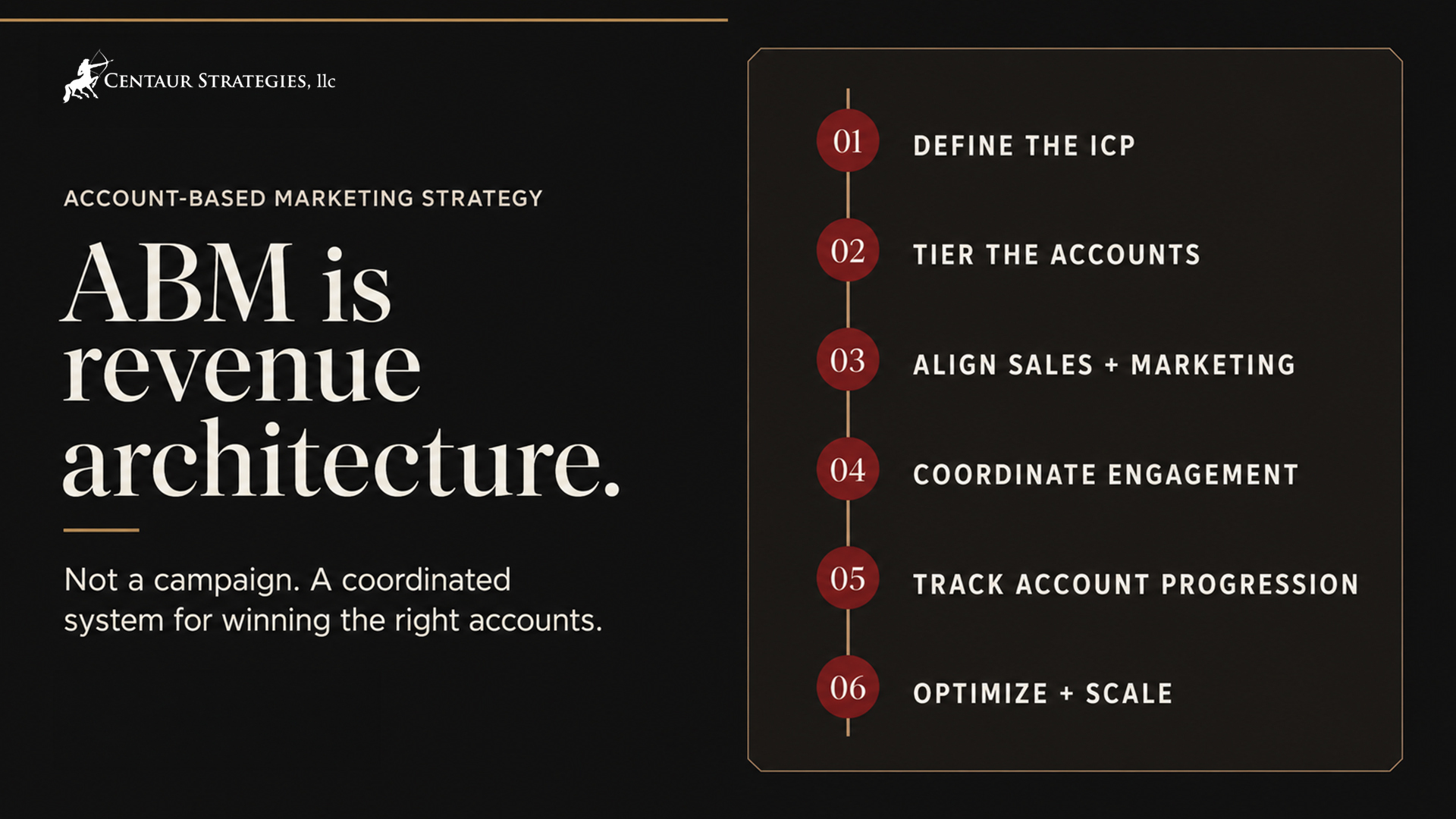
When ABM is treated as revenue architecture, it means three things have been decided at the organizational level before a single campaign is launched:
First, the Ideal Customer Profile has been jointly defined by sales and marketing, not by marketing alone or sales alone, but by both functions together, with input from customer success data, win/loss analysis, and the historical deal records that show what accounts actually became profitable, long-term customers versus which ones churned at twelve months.
Second, the go-to-market motion has been rebuilt around account progression rather than lead volume. This is the most consequential shift. Traditional demand generation measures success in leads generated, MQLs created, and pipeline sourced. ABM measures success in accounts engaged, accounts progressed through defined stages, and accounts influenced to close. These are not cosmetic metric changes, they reflect a fundamentally different theory of how revenue gets created.
Third, sales and marketing incentives and KPIs are aligned at the account level. If marketing is measured on lead volume and sales is measured on individual quota, ABM will fail regardless of tactical quality. Revenue architecture means the incentive structure is rebuilt to reward joint account advancement, because ABM is, at its core, a coordinated effort that cannot be executed by either function working independently.
The Three-Tier Account Model: Foundation of ABM Account Based Marketing
Every effective ABM account based marketing program is built on a tiered account structure. Not all target accounts receive the same investment of time, budget, and personalization, nor should they. The three-tier model allocates resources proportionally to account potential.
Tier 1 – Strategic Accounts (High-Touch ABM): These are your most valuable prospective accounts, typically 10 to 50 companies that represent transformative revenue potential or exceptional strategic fit. Tier 1 accounts receive fully custom, one-to-one engagement: bespoke content developed specifically for that account’s industry, business model, and stated priorities; multi-channel outreach coordinated between marketing and sales; executive-level relationship building; and dedicated measurement at the account level.
This tier is expensive to execute well. It should be. The expected return per closed account justifies the investment significantly.
Tier 2 – Named Accounts (Personalized ABM): These are accounts that fit your ICP well and represent strong revenue potential but don’t require the resource intensity of Tier 1. They receive industry- or persona-specific content rather than account-specific, coordinated outreach with some personalization layer, and active engagement tracking. Tier 2 typically encompasses 100 to 500 accounts.
Tier 3 – Programmatic Accounts (Automated ABM): A broader list, often several thousand companies, that match your ICP profile and receive targeted content and messaging through automated channels. The experience is more consistent than standard demand generation but lacks the personalization depth of Tiers 1 and 2. Programmatic ABM covers the volume layer and feeds qualified accounts upward into higher tiers as engagement signals emerge.
The tier model matters because it forces the resource allocation conversation. Most organizations that fail at ABM have not made this decision explicitly, they attempt to treat all target accounts as Tier 1 quality and run out of budget and bandwidth within a quarter.
Also check: Amazon vs Walmart vs Shopify in 2026: Which Platform Actually Grows Your Revenue Faster?
Aligning Sales and Marketing: The Non-Negotiable Prerequisite
No working ABM strategy functions without sales and marketing alignment. This point appears in every piece of ABM content ever written, and it is still the most common reason programs fail, not because it is poorly understood, but because the alignment required is genuinely difficult and most organizations underestimate what it demands.
Alignment in the context of ABM means shared account selection, shared account data, coordinated engagement timing, and shared success metrics. It means a weekly or biweekly sales and marketing sync at the account level, not a pipeline review meeting, but a conversation about which accounts are engaging with what content, what that signals about their stage and priorities, and how sales should adjust their outreach accordingly.
It means marketing stops caring about lead volume and starts caring about whether the accounts it’s engaging are the same accounts sales is trying to open. It means sales stops treating marketing as a lead factory and starts treating marketing as a function that makes their conversations warmer and their close rates higher.
The organizations that get this right tend to do so through a RevOps function or a dedicated ABM program owner who sits between sales and marketing and manages the account list, the data flow, and the shared performance reporting. Without that structural connection, the two functions will drift back toward their natural motions within weeks.
Account Based Marketing Metrics That Actually Matter
The account based marketing metrics most commonly cited in ABM retrospectives, impressions served to target accounts, email open rates from named accounts, account reach percentage, are vanity metrics dressed in ABM language. They measure the presence of activity, not the presence of impact.
The metrics that indicate your ABM program is functioning as revenue architecture rather than campaign theater are different in kind, not just in calculation.
Account Engagement Score. A composite measure of meaningful interactions from key decision-makers at a target account: website visits from identified account domains, content consumption, event attendance, direct response to outreach, and social engagement with company content. Tracked over time, account engagement score shows whether an account is moving toward you or remaining inert.
Account Stage Progression Rate. What percentage of your Tier 1 and Tier 2 target accounts moved from one defined stage to the next in a given period? This is the ABM equivalent of pipeline velocity, and it is the most direct indicator of whether your coordinated marketing and sales activities are producing forward movement.
Pipeline Contribution from Target Accounts vs. Non-Target Accounts. Of the pipeline your company generated this quarter, what percentage came from accounts on your ABM list? If ABM is working, this number should be growing over time. If it is not, the program needs to be diagnosed, either the account selection is wrong, the engagement quality is insufficient, or the sales motion is not converting ABM-generated interest into qualified pipeline.
Deal Size and Win Rate: Target vs. Non-Target Accounts. ABM should produce larger deals and higher win rates among target accounts compared to accounts that came in through standard demand generation. If it doesn’t, the program is not differentiating your company in the ways that matter to those accounts.
Time-to-Close: Target Account Cohort. Sales cycles at ABM target accounts that have been engaged across multiple channels and stages for 90-plus days before entering a formal sales process should close faster than cold inbound. If they don’t, your pre-sale engagement is not building the trust and credibility that ABM is supposed to create.
The Account Is the Right Unit for Investment and the Wrong Unit for Measurement
Tiering is an account decision. Budget, resourcing, and how much bespoke work an opportunity justifies all belong at the account level, and the tier model handles them well.
Measurement is where the unit breaks. A rising account engagement score can mean one person is deeply engaged or five people are mildly engaged. Those are different accounts requiring different next moves, and the score reports them the same way.
Stage progression carries the same defect. Stages describe what your sales process does, not what a buying committee does. Individuals form views at different times, in a different order, on different evidence. The committee does not advance. People advance separately, and then a decision surfaces.
There is also the champion problem. Most people on a buying committee believe they hold real influence over the outcome. Some of them are wrong, and the ones who are wrong will tell you they are not. A program built around a single identified champion is built on one person’s self-assessment.
The correction is not to abandon account-level measurement. It is to hold two units at once. The account is the unit of investment. The individual is the unit of messaging and signal. Programs that collapse the second into the first end up personalizing to an average of four people, which is another way of describing generic.
The Buying Committee Includes Something You Cannot Email
Buyers now use AI tools to summarize vendors, compare options, and narrow shortlists before contacting anyone. Two consequences follow for an ABM program, and neither is a content marketing concern to be handled later.
The first is that part of the evaluation happens off your instrumentation entirely. An account can be actively forming a view of you while producing no signal you can see. No site visit, no download, no email open. The engagement score reads inert. The account is not inert. Every metric in the previous section carries this blind spot, and no ABM platform closes it.
The second is that you now have a reader you cannot personalize for. ABM assumes the recipient is a person you can research and address. A model summarizing your positioning against three competitors is not moved by a personalized landing page. It moves based on whether your material is structured, specific, and retrievable enough to summarize accurately. If your positioning only makes sense to someone who reads the whole page in order, it will not survive the summary, and the summary is what reaches the committee.
On infrastructure, the useful part is short. A CRM that tracks account level history, an intent source, and automation that can segment at the account level. Everything past that is optimization rather than foundation, and the structural decisions about account selection, tier assignment, alignment, and account level KPIs have to be made before any platform is bought.
Where to Start: Building an ABM Program That Survives the First Quarter
Most ABM programs fail in the first 90 days, not because the strategy was wrong, but because the scope was unmanageable. Teams attempt to activate 500 Tier 1 accounts simultaneously, build personalized content for every vertical in the first month, and measure success before the program has had time to generate signal.
The practical starting point: choose 10 to 15 Tier 1 accounts, build a genuine understanding of each one’s business priorities and decision structure, develop a small number of content assets that speak directly to those priorities, and coordinate a single coordinated marketing and sales motion around those accounts for 90 days. Measure account engagement and stage progression. Learn what works. Expand deliberately.
This is not a small program; it is a focused program. The focus is what makes it work.
Build the Architecture Before the Program
The failure pattern in ABM is not tactical. Teams that struggle almost never struggle because the content was weak or the sequence was wrong. They struggle because marketing built the account list alone, incentives still reward lead volume, and nobody owns the account data between the two functions. Those are structural conditions, and no amount of campaign quality survives them.
That is why Centaur starts with a diagnostic rather than a program build. The Growth Readiness Assessment examines whether the conditions ABM requires actually exist in your operation: how the ICP was defined and by whom, whether sales and marketing are measured on compatible things, where account data lives and who can act on it, and what happens today when the two functions disagree about an account.
The finding is written and it is yours. Sometimes it says the architecture is sound and the work is tactical. More often it says the layer underneath has not been built, and that a program launched on top of it will produce engagement statistics rather than revenue. Knowing which situation you are in is worth more than another quarter of tactics.
Call 619 889 3229 or email info@centaurstrategies.net
Frequently Asked Questions (FAQs)
Q1. What is account based marketing strategy and how is it different from traditional demand generation?
A. An account based marketing strategy flips the traditional demand generation funnel. Instead of generating a large volume of leads and filtering for qualified ones, ABM starts by identifying the specific accounts you want to win and builds coordinated marketing and sales activity around those accounts. Traditional demand generation optimizes for lead volume. ABM optimizes for account quality, relationship depth, and deal size within a defined target set.
Q2. How many accounts should be in an ABM program?
A. It depends on your tier structure and organizational capacity. A Tier 1 (high-touch) program typically involves 10 to 50 accounts. A Tier 2 (personalized) layer can extend to several hundred. A Tier 3 (programmatic) layer may include thousands. The critical principle is that the investment per account must be proportional to the expected revenue per account, and most organizations that underperform at ABM have either selected too many Tier 1 accounts or failed to differentiate between tiers entirely.
Q3. What are the most important account based marketing metrics to track?
A. The most meaningful account based marketing metrics are those that measure account progression rather than campaign activity. Key metrics include account engagement score, account stage progression rate, pipeline contribution from target versus non-target accounts, deal size and win rate comparison (ABM versus non-ABM accounts), and time-to-close for accounts that received multi-channel ABM engagement versus cold inbound. These metrics require CRM integration and account-level attribution but provide a genuine view of ABM’s revenue contribution.
Q4. What does ABM account based marketing require to succeed?
A. The three non-negotiable prerequisites for ABM account based marketing are: joint account selection by sales and marketing based on ICP data, alignment on account-level KPIs that replace or complement traditional lead metrics, and consistent coordination between marketing and sales on account engagement timing and content. Without all three, ABM programs drift into campaign-mode execution and underperform against their strategic potential.
Q5. How long does it take for an ABM program to show results?
A. Most well-structured ABM programs begin showing meaningful account engagement improvements within 60 to 90 days. Pipeline influence from ABM-engaged accounts typically becomes visible in the 90-to-180-day window, depending on your sales cycle length. Revenue impact, reflected in deal size, win rate, and close rate comparisons between ABM and non-ABM accounts, generally requires 6 to 12 months of consistent program execution to measure with statistical confidence.
Q6. Do I need a dedicated ABM platform or technology to run ABM?
Not at the start. The minimum is a CRM that tracks account level engagement, marketing automation that can segment by account, and an intent source that flags when target accounts are researching relevant topics. Specialized platforms add value at scale, but they amplify a working motion rather than create one. The more useful question is not which platform to buy. It is whether your account data is available to both sales and marketing in a form either function can act on, because no platform fixes that.
Q7. Can Centaur Strategies help build and execute an account based marketing strategy?
Yes, though the engagement usually starts a step earlier than clients expect. Before ICP definition, tier modeling, content strategy, or measurement design, Centaur assesses whether the organization can support an ABM motion at all: whether account selection is genuinely joint, whether the incentive structure rewards account advancement, and whether account level data is available to both functions. Programs that skip that step tend to produce engagement statistics. Programs that clear it tend to work.