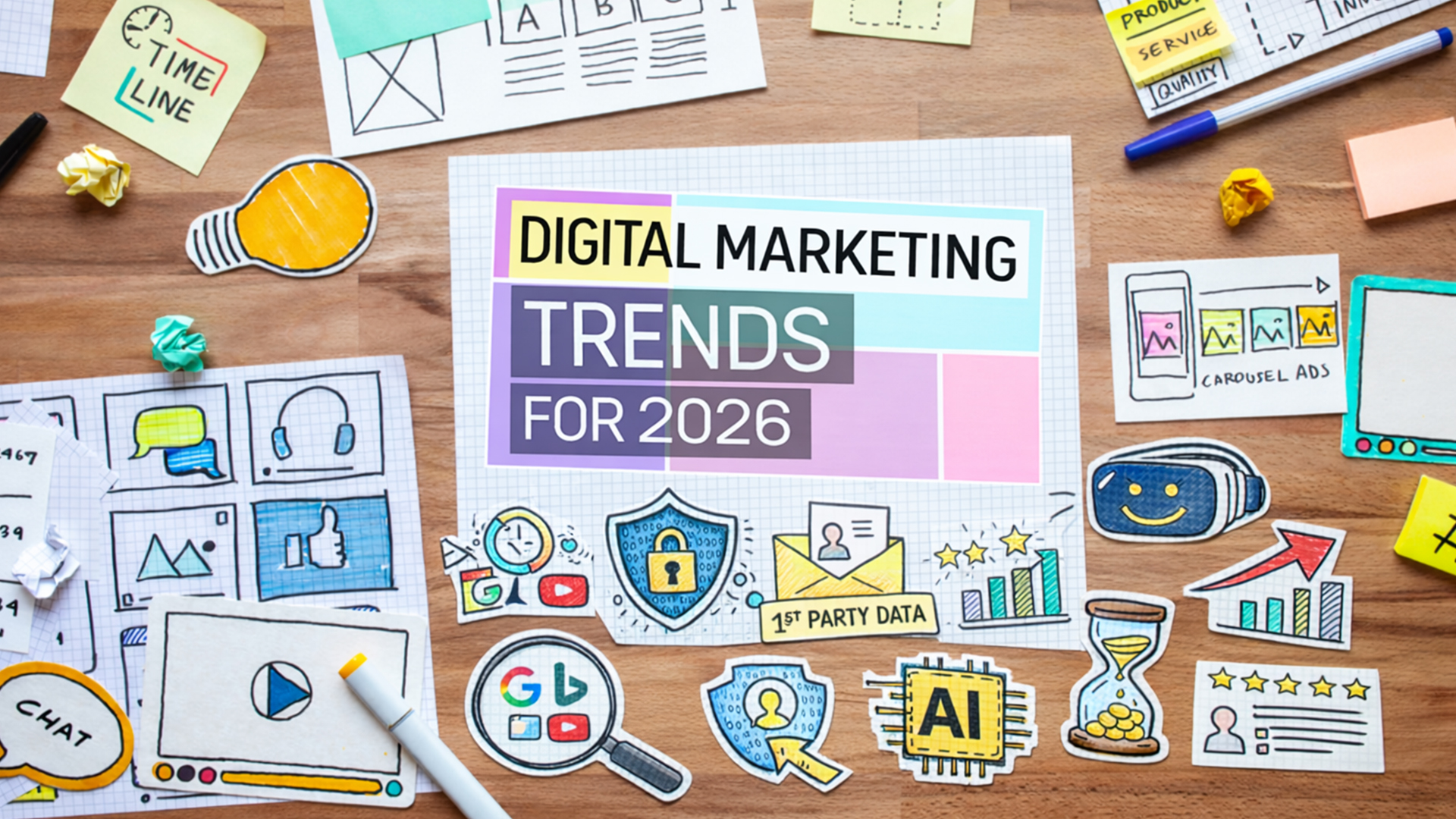
The digital marketing landscape never stands still, but 2026 marks a particularly significant shift. With artificial intelligence moving from novelty to necessity, privacy regulations reshaping data collection, and consumer trust at an all-time low, businesses face a critical question: which trends actually matter?
Every year brings a flood of “must-watch” marketing predictions, yet most disappear by Q2. The difference in 2026? Many of these trends aren’t emerging, they’re already here, and businesses that haven’t adapted are falling behind. According to Gartner’s 2025 CMO Survey, 73% of marketing leaders report feeling “overwhelmed” by the pace of technological change, yet only 41% have a clear prioritization strategy.
This guide cuts through the noise to focus on digital marketing trends 2026 that will genuinely impact your bottom line. We’ll explore what’s changing, why it matters, and most importantly, what to do about it.
Why Strategic Prioritization Matters More Than Ever
The average marketing team now manages 15-20 different tools and platforms, up from just 8-10 in 2020, according to HubSpot’s State of Marketing Report. Yet despite this technological expansion, customer acquisition costs (CAC) have increased by an average of 60% over the past five years.
The Modern Marketing Paradox:
- More tools, but lower efficiency
- More data, but less clarity
- More channels, but harder to reach customers
- More content, but declining engagement
Why This Happens: Without clear business marketing priorities 2026, teams spread themselves too thin. They chase every shiny new platform, adopt every trending tactic, and end up doing nothing particularly well. The solution isn’t working harder, it’s working smarter by focusing on trends with lasting impact.
At Centaur Strategies, we help businesses cut through the noise and focus on digital marketing strategies that deliver measurable results — as a full service digital marketing agency in San Diego, we turn strategy into revenue.
The 5 Digital Marketing Trends That Will Define 2026
1. AI-Powered Marketing Operations
Artificial intelligence has graduated from experimental technology to essential infrastructure. In 2026, AI isn’t about replacing marketers, it’s about amplifying their capabilities.
How Businesses Are Using AI:
Content Creation & Optimization: Tools like ChatGPT, Claude, and Jasper help marketers draft content and optimize it for SEO. The winning approach? AI-assisted human creativity. Businesses using AI for initial research, then adding human expertise, see 3x better engagement.
Predictive Analytics: AI tools now predict which leads will convert, which customers might churn, and which content will resonate, before you publish. Platforms like Salesforce Einstein analyze historical data to guide real-time decisions.
Automated Campaign Optimization: Google Ads and Meta’s AI-powered optimization adjust bidding, targeting, and creative elements in real-time. Businesses using automated bidding report 20-35% lower cost-per-acquisition.
Personalization at Scale: AI enables true 1:1 personalization across thousands of customers. Dynamic content based on user behavior is becoming baseline, not luxury.
Action Steps:
- Start with one AI tool focused on your biggest pain point
- Train your team on AI best practices
- Establish clear guidelines for AI use, especially around brand voice
- Monitor AI-generated content closely, quality control remains essential
Pro Tip: Looking to implement AI-driven marketing automation? Our team at Centaur Strategies can help you integrate these tools effectively. Contact us for a free consultation.
2. First-Party Data as Your Most Valuable Asset
With third-party cookies crumbling and privacy regulations tightening (GDPR, CCPA), first-party data, information customers voluntarily share directly with you, has become marketing gold.
Why First-Party Data Matters:
Privacy Compliance: Collecting data directly with clear consent ensures compliance with current and future regulations.
Better Accuracy: Your own customer data is more accurate than purchased third-party data that’s often outdated.
Competitive Advantage: Your first-party data is unique, competitors can’t access it.
Cost Efficiency: Reduces dependency on expensive paid advertising targeting.
How to Build First-Party Data:
Value Exchange Strategy: Offer genuine value for data, free tools, exclusive content, loyalty programs, early access, or personalized recommendations.
Progressive Profiling: Don’t ask for everything at once. Start with email, then gradually request more as trust builds. Forms with 3 fields convert 2x better than those with 8+.
Leverage Your Data:
- Email marketing (delivers $36 return for every $1 spent, per Litmus research)
- Retargeting campaigns using customer match lists
- Lookalike audiences based on best customers
- Personalized website experiences
Tools to Consider: Segment, HubSpot, Salesforce, Klaviyo, Google Analytics 4
Action Steps:
- Audit what first-party data you currently collect
- Create lead magnets offering real value
- Implement progressive profiling in forms
- Ensure clear privacy policies and easy opt-out
Need help building a robust data strategy? Learn more about our Analytics and Reorting services.
3. Search Evolution: Beyond Google
Traditional SEO isn’t dead, but search behavior is radically evolving. In 2026, “search” happens across multiple platforms.
The New Search Landscape:
AI Search Engines: ChatGPT, Perplexity AI, and Google’s AI Overviews are changing how people find information. Users get direct answers instead of clicking through links.
Platform-Based Discovery:
- TikTok: 40% of Gen Z use it instead of Google for local searches
- Amazon: 54% of product searches start here, not Google
- YouTube: World’s second-largest search engine
- Instagram & Pinterest: Visual search growing exponentially
Voice Search: With smart speakers in 35% of US homes, voice queries are longer and more conversational.
How to Adapt:
For AI Search: Create comprehensive, authoritative content with clear structure. Include original research that AI tools will cite.
For Platform Search:
- TikTok: Short-form video answering common questions
- YouTube: “How-to” video content
- Amazon: Optimized product listings
- Pinterest: Keyword-rich visual pins
For Voice Search: Optimize for conversational questions, focus on local SEO, create FAQ pages with natural language.
Action Steps:
- Identify where your audience searches beyond Google
- Create content optimized for each platform’s format
- Track visibility across multiple search platforms
- Experiment with video and short-form content
At Centaur Strategies, we specialize in SEO and multi-channel marketing that ensures your brand is visible wherever your customers are searching.
4. Trust-Based Content Over Volume
The internet is drowning in content, 7 million blog posts daily, 500 hours of YouTube video per minute. Standing out requires shifting from quantity to quality.
Why Trust Matters:
According to the 2025 Edelman Trust Barometer, only 48% of consumers trust businesses to “do the right thing.” Brands that build genuine trust win long-term loyalty.
What Trust-Based Content Looks Like:
Original Research & Data: Conduct surveys, analyze industry data, share case studies. Original data gets cited, linked, and shared.
Expert Insights: Feature interviews with industry experts, customer success stories, or thought leadership. First-hand experience carries more weight.
Transparent Communication: Address limitations, acknowledge competitors, be honest about what works and doesn’t. Admitting imperfection builds trust.
Depth Over Breadth: One comprehensive 2,000-word article creates more value than ten shallow 200-word posts.
Implementation Strategy:
- Weekly deep-dive articles with original insights
- Monthly original research reports
- Quarterly comprehensive guides
- Case studies showing real results with numbers
- Video interviews with customers or experts
Action Steps:
- Audit content quality, delete or improve underperforming content
- Focus on topics where you have genuine expertise
- Interview customers and create case studies
- Measure engagement depth, not just pageviews
Looking to create authoritative content that builds trust with your audience? Check out our content marketing services or explore our latest blog insights.
5. Experience-Led Marketing
The line between marketing and product experience is blurring. In 2026, customer experience is marketing.
Why Experience Matters:
53% of mobile users abandon sites taking over 3 seconds to load (Google research). Customers expect consistent, seamless experiences whether on website, app, social media, or in-store. Acquiring a new customer costs 5-25x more than retaining one great experience drives retention.
What Experience-Led Marketing Includes:
Website Performance: Fast loading (under 2 seconds), mobile optimization (60%+ of traffic), intuitive navigation, clear calls-to-action.
Personalization: Dynamic content based on behavior, product recommendations, tailored email journeys, customized landing pages.
Seamless Journeys: Easy checkout, consistent messaging across channels, integrated support, post-purchase follow-up.
Action Steps:
- Run website speed tests and optimize
- Map customer journey, identify friction points
- Implement live chat for immediate support
- Create mobile-first experiences
- Use Hotjar or Microsoft Clarity to see user navigation
Our Website Development and Hosting services ensure your website not only looks great but delivers exceptional user experiences that convert visitors into customers.
2026 Marketing Trends Priority Matrix
Trend | Business Impact | Implementation | ROI Timeline | Priority |
AI-Powered Operations | High | Medium | 3-6 months | CRITICAL |
First-Party Data | Very High | Medium | 6-12 months | CRITICAL |
Multi-Platform Search | High | Medium | 6-12 months | HIGH |
Trust-Based Content | Very High | High | 12+ months | HIGH |
Experience Marketing | High | Medium | 3-9 months | HIGH |
Implementation Roadmap
Phase 1: Assessment (Month 1)
- Audit current marketing performance
- Identify data collection gaps
- Evaluate relevant AI tools
- Assess website performance
Phase 2: Quick Wins (Months 2-3)
- Implement basic AI tools
- Optimize website speed
- Create lead magnets for data collection
- Improve top content for trust signals
Phase 3: Strategic Implementation (Months 4-9)
- Develop first-party data strategy
- Create original research
- Expand to new search platforms
- Implement AI for personalization
Phase 4: Optimization (Months 10-12)
- Analyze and double down on what works
- Refine AI usage
- Scale winning channels
- Prepare for 2027
Need help creating a customized implementation plan? Our Management Consulting and Project Management team in San Diego develops strategic roadmaps tailored to your business goals, pipeline growth, and long-term revenue performance.
Key Metrics to Track
AI Implementation: Time saved, content efficiency, campaign ROI, engagement
First-Party Data: Email list growth, data collection points, engagement rates, Customer Lifetime Value
Search Expansion: Multi-platform visibility, non-Google traffic, video engagement, platform conversions
Trust Content: Time on page, backlinks earned, social shares, return visitors
Experience Marketing: Load speed, bounce rate, conversion rate, customer satisfaction (NPS)
Our Analytics and Strategic Goals services provide comprehensive tracking and reporting to measure what matters most to your business.
Common Pitfalls to Avoid
- Technology Over Strategy: Don’t adopt tools just because they’re trendy
- Ignoring Your Audience: Trends matter, but your specific audience matters more
- Expecting Instant Results: Building data, trust, and experience takes time
- Neglecting Basics: Don’t chase advanced tactics while ignoring fundamentals
- Spreading Too Thin: Better to excel at 2-3 channels than be mediocre at 10
Industry-Specific Focus
B2B: First-party data, trust-based content, LinkedIn, AI for lead scoring
E-commerce: Experience optimization, multi-platform search (Amazon, Google Shopping), AI personalization
Local Business: Voice search, Google Business Profile, first-party data via loyalty programs
SaaS: Product-led growth, educational content, experience, free trials
Whether you’re B2B, B2C, or managing an e-commerce store, our team at Centaur Strategies has the expertise to help you succeed. We specialize in E-commerce Development and Management for online retailers for businesses of all sizes.
Conclusion: Building a Future-Proof Strategy
The emerging marketing trends 2026 aren’t isolated tactics, they’re interconnected shifts that reinforce each other. AI helps you use first-party data effectively. Trust-based content improves visibility across search platforms. Great experiences turn visitors into loyal customers who share data willingly.
Success in 2026 isn’t about chasing every platform or tool. It’s about strategic focus: identifying the top digital marketing trends 2026 that align with your business goals, implementing them thoughtfully, and consistently delivering value.
The Winning Formula:
- Use AI to work smarter, not just faster
- Own your customer data and relationships
- Show up where customers actually search
- Build trust through quality, not quantity
- Create experiences that delight
Start with one trend this month. Master it. Then move to the next. Sustainable growth comes from consistent progress, not overnight transformation.
Ready to transform your digital marketing strategy for 2026? Contact Centaur Strategies for a free consultation. Our team of experts will help you prioritize the right trends, implement proven strategies, and achieve measurable growth.
FAQs
Q1. What are the most important digital marketing trends for 2026?
Ans. The five most impactful trends are: (1) AI-powered marketing operations, (2) First-party data strategies, (3) Multi-platform search optimization beyond Google, (4) Trust-based content prioritizing quality, and (5) Experience-led marketing creating seamless journeys. These trends interconnect and reinforce each other when implemented strategically. At Centaur Strategies, we help businesses identify which trends will have the biggest impact on their specific goals and industry.
Q2. How do businesses decide which trends to prioritize?
Ans. Evaluate each trend against business impact, implementation difficulty, and ROI timeline. Align with your specific business model, B2B might prioritize LinkedIn and trust content, while e-commerce focuses on multi-platform search and experience. Start with your biggest pain point or opportunity. Our management consulting team can help you develop a customized prioritization framework.
Q3. How can small businesses with limited budgets implement these trends?
Ans. Start small and focused. Use free AI tools (ChatGPT, Google’s AI), build email lists with simple lead magnets, optimize your Google Business Profile, and create one high-quality monthly piece instead of daily mediocre posts. Small businesses compete through authenticity and responsiveness, use that advantage. Contact us to discuss budget-friendly strategies tailored to your business size.
Q4. What’s the biggest mistake businesses make with digital marketing in 2026?
Ans. Chasing every trend without strategy. Businesses adopt tools because competitors use them, not because they solve problems. Result? Wasted budget, confused teams, no improvement. Solution: Choose 2-3 trends aligned with goals, implement thoroughly, measure results, then expand. Depth beats breadth. Our digital marketing services focus on strategic implementation over trend-chasing.
Q5. How often should we review our marketing strategy?
Ans. Conduct quarterly reviews for tactical adjustments and annual strategic planning for major shifts. Stay flexible if platforms change dramatically or new technology emerges; pivot quickly. Balance consistency (don’t change weekly) with adaptability (don’t ignore important changes). We provide ongoing analytics and strategic guidance to keep your strategy current.
Q6. How do we measure ROI for trust-based content?
Ans. Track leading indicators: time on page, scroll depth, return visitors, backlinks earned, brand mentions. For revenue, use multi-touch attribution showing how trust content influences conversions over time. One comprehensive guide can generate leads for years, calculate Customer Lifetime Value of those leads. Our analytics consulting services in San Diego help you track both short-term metrics and long-term brand building